
What is a GHG accounting standard?
A GHG accounting standard is a set of rules and guidelines that organizations use to measure, track, and report their GHG emissions. Just like financial accounting has standards (e.g., GAAP, IFRS) to ensure consistency and credibility, GHG accounting standards ensure that emissions are measured credibly, transparently, and consistently to allow for comparison across time, companies, and industries.
Most GHG accounting standards provide organizations with a framework for deciding which parts of their operations and value chain to include in their GHG accounts and a system for classifying different types of emissions (e.g., direct and indirect emissions). These standards also typically include:
- Suggested methods for converting activity data (e.g., fuel use, electricity) into emissions using emission factors
- Best practices for recording assumptions, sources, and methods used in calculations
Which standards are commonly used in Canada?
Canadian businesses typically draw from a mix of international and domestic frameworks when deciding which GHG accounting standard to use.
GHG Protocol (Corporate Standard)
The GHG Protocol Corporate Standard was developed by the World Resources Institute (WRI) and the World Business Council for Sustainable Development (WBCSD). First released in 2001, it has become the foundational framework for greenhouse gas accounting worldwide. It provides clear guidance for measuring and reporting Scope 1 (direct), Scope 2 (indirect from purchased energy), and Scope 3 (value chain) emissions, and it serves as the basis for many other standards. The Corporate Standard is freely available through the GHG Protocol website (https://ghgprotocol.org/).
GHG Protocol Scope 3 Standard
The GHG Protocol Scope 3 Standard, also developed by WRI and WBCSD, expands on the Corporate Standard by providing detailed methods for measuring and reporting value chain emissions. It covers fifteen categories of Scope 3 activities, ranging from purchased goods and services to product use, waste, and transportation. This standard can be accessed through the GHG Protocol website (https://ghgprotocol.org/).
ISO 14064-1
The ISO 14064-1 standard is part of the ISO 14000 environmental management series created by the International Organization for Standardization. It sets requirements for quantifying and reporting GHG emissions and removals at the organizational level and is designed for third-party verification. This makes it attractive for organizations seeking external assurance and credibility with investors. Because ISO standards are copyrighted, the ISO 14064-1:2018 standard must be purchased through the ISO website (https://www.iso.org/home.html).
Science-Based Targets initiative (SBTi)
The Science-Based Targets initiative (SBTi) is a partnership between CDP, WRI, WWF, and the UN Global Compact. Its purpose is to help companies set emissions-reduction targets that align with the goals of the Paris Agreement, especially the commitment to limiting global warming to 1.5°C. Companies submit their targets for validation by the SBTi, which confirms whether they meet the criteria. More information is available at the SBTi website (https://sciencebasedtargets.org/).
CDP (formerly Carbon Disclosure Project)
The CDP was founded in the UK in 2000 as a not-for-profit that operates a global disclosure system. Each year, CDP collects information from companies through a detailed questionnaire covering emissions, climate risks, opportunities, and strategies. Responses are scored from A (leadership) to D (disclosure only). The disclosure system can be accessed through the CDP website (https://www.cdp.net/en).
Global Reporting Initiative (GRI) Standards
Founded in the Netherlands in 1997, GRI is an independent organization that developed one of the most widely used sustainability reporting frameworks. The GRI Standards provide comprehensive guidance for reporting on environmental, social, and governance (ESG) performance, including emissions. While GHG reporting within GRI aligns with the GHG Protocol, the framework extends beyond emissions to cover broader sustainability topics. The standards are publicly available through the GRI website (https://www.globalreporting.org/).
Environment and Climate Change Canada (ECCC) Reporting Guidance
ECCC publishes reporting guidance under the Greenhouse Gas Reporting Program (GHGRP). This guidance applies to facilities in Canada that emit 10,000 tonnes of CO₂e or more annually, with detailed reporting required above 50,000 tonnes. It sets out the calculation methods and categories required for compliance with Canadian law. More information is available through ECCC’s GHG Reporting Program website (https://open.canada.ca/data/en/dataset/a8ba14b7-7f23-462a-bdbb-83b0ef629823).
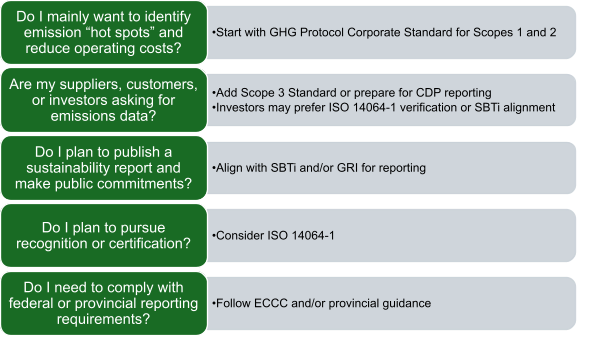
Key questions to ask when choosing a standard
Where can I find more information on GHG accounting standards?
GHG Protocol (Corporate Standard)
https://ghgprotocol.org/sites/default/files/standards/ghg-protocol-revised.pdf
GHG Protocol Scope 3 Standard
https://ghgprotocol.org/sites/default/files/2023-03/Scope3_Calculation_Guidance_0%5B1%5D.pdf
ISO 14064-1
https://www.iso.org/standard/66453.html
Science-Based Targets initiative (SBTi)
https://sciencebasedtargets.org/net-zero
CDP
https://www.cdp.net/en/disclose/question-bank
Global Reporting Initiative (GRI) Standards
https://www.globalreporting.org/standards/download-the-standards/
Environment and Climate Change Canada (ECCC) Reporting Guidance
